Sticker GO!
- 3.9
- Rating
- 5.00M
- Installs
- Free
- Price

 Analysis by App-foxy
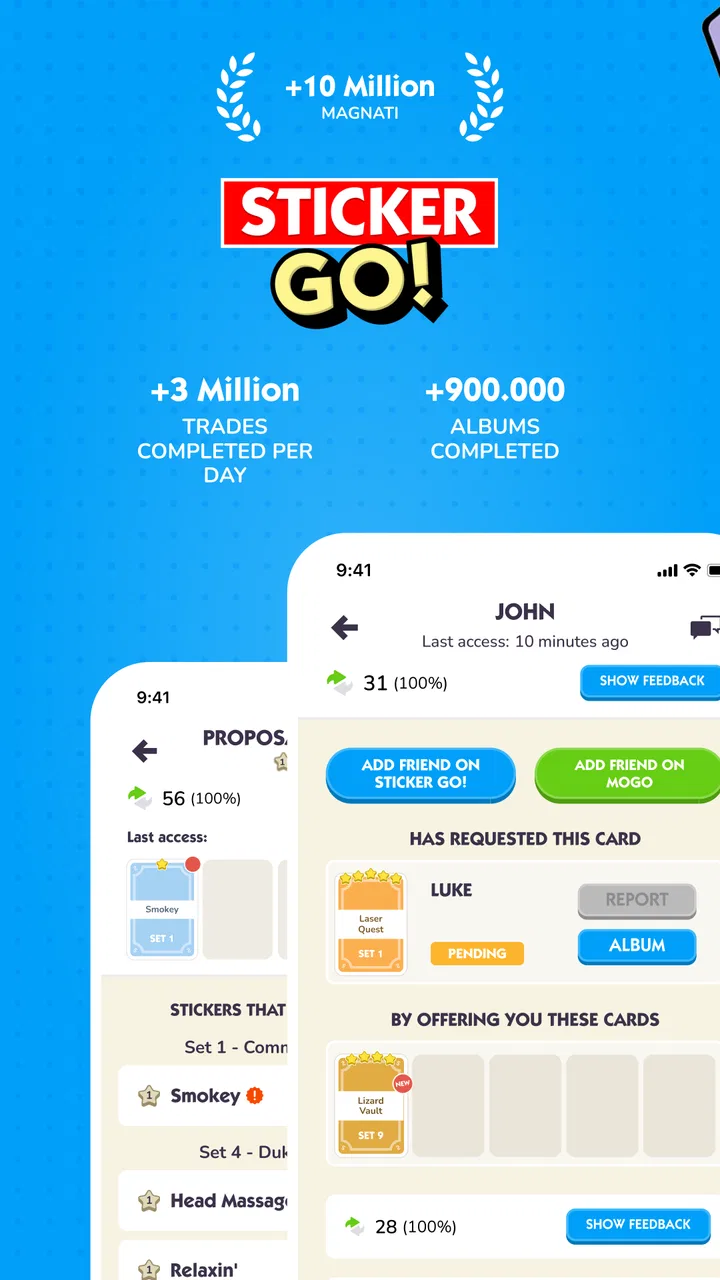
I went into Sticker GO! expecting a simple board-style game built around collecting, but its real appeal is more social and routine-driven. The main idea is to trade stickers and stay connected with other players, so progress depends less on one long session and more on how consistently you check your collection, notice useful duplicates, and make sensible exchanges. That gives it a different rhythm from a traditional board game, even though its presentation and category place it there.
The game is made by Ganko and is free to start, with optional in-app purchases priced from $1.99 to $39.99 per item. It is rated for Everyone, which makes it approachable for younger players and families, although I would still treat any game with optional spending as something worth supervising. With a 3.9 average from around 61 thousand ratings and more than 5 million installs, it clearly has a sizeable player base. That matters here because a trading-focused game is much more enjoyable when there are plenty of people around to exchange with.
How the everyday sticker routine works
My preferred way to play is not to treat Sticker GO! as a game that needs constant attention. I open it when I have a spare moment, look over what I already have, and then decide whether there is a worthwhile reason to trade. That small pause is important. If I simply accept every possible exchange, I can easily use up useful duplicates or end up with a collection that looks busy but does not move toward anything meaningful.
You May Also Like

 Blood Strike: 2.5 Anniversary
Blood Strike’s Loadouts Turn Every Drop Into a Tactical Gamble
A close look at Blood Strike’s custom loadouts: how fast access to signature weapons reshapes its battle royale rhythm, rewards preparation, and narrows the gap between fights.

 Pandora - Music & Podcasts
Pandora’s Music Is Easy to Start, but Harder to Recover
Pandora’s strength is its low-effort path from a seed to a station. Its weak spot is how much confidence it asks you to place in connection, setup, and quiet recovery.

 8 Ball Pool
 Is Built on Rivalries, Rematches, and Routine
A close look at the rivalries, rematches, shared routines, and unanswered safety questions that turn a quick pool match into a persistent mobile community.

 Samsung Music
’s Quiet Strength Is Playing What You Already Own
Its reach comes less from spectacle than from dependable access to a personal library. That simplicity is both the app’s strongest retention engine and its ceiling.

 AccuWeather: Weather Radar
AccuWeather Review: A Quick, Clear Forecast for Everyday Decisions
For everyday plans, the best forecast is the one you can understand quickly. AccuWeather makes rain timing, radar, and local conditions easy to act on, with a few trade-offs.

 Hill Climb Racing
Why Hill Climb Racing Still Turns Crashes Into One More Run
A tiny car, a bumpy hill and one more upgrade: Hill Climb Racing keeps resurfacing because its simple chaos makes every near-miss feel personal.
More From Our News Desk



The first useful habit is to separate stickers into three mental groups: pieces I am still trying to obtain, duplicates that may help another player, and duplicates I should keep because they could be useful in a later exchange. The game becomes much easier to manage when I stop viewing every spare sticker as disposable. A duplicate is not automatically excess; its value depends on what I need next and what other players are likely to want.
This is where the community element changes the experience. In many ordinary board games, the other players are sitting beside you or are controlled by the game. Here, trading is the reason to pay attention to the wider player community. A good exchange can feel more satisfying than simply receiving a random reward because I have made a decision that improves my collection. The trade-off is that the quality of the experience depends on how active and cooperative the available community feels at the time.
A realistic everyday scenario would be playing during a commute or while waiting for an appointment. I would check the current collection, identify one or two missing stickers that matter to my immediate goal, and review duplicates before making any decisions. If an exchange is not useful, I leave it alone rather than turning a short session into aimless tapping. That approach keeps the game light and prevents the collection from becoming difficult to understand.
Players who enjoy completing sets, comparing progress, and helping others will probably find this loop naturally satisfying. It is also a reasonable choice for someone who wants a casual mobile game that can be visited in short bursts rather than played continuously. On the other hand, anyone looking for a deep strategy board game, a fast competitive match, or a campaign with a strong narrative may find the sticker-trading focus too narrow.
What I would check before making the first trades
The most important preparation is simply learning how the collection is organized. Before trading, I spend time looking at the stickers I already own and the gaps that remain. This sounds obvious, but it prevents a common mistake: trading away an item that seems unimportant because it is duplicated, only to realize later that keeping it would have made a better exchange possible.
I also recommend deciding on a short-term target instead of trying to complete everything at once. A collection can feel overwhelming when every missing item looks equally urgent. Choosing one set, group, or immediate milestone gives each trade a purpose. It also makes it easier to judge whether an offer is genuinely useful rather than merely attractive because it contains something unfamiliar.
The game is free, so there is no financial barrier to trying the basic experience. Still, the optional purchases deserve a deliberate approach. I would not spend simply because progress feels slow during one session. Waiting, checking available trades, and reviewing what I already possess are better first steps. Spending can be tempting in collection games because a missing item feels personal, but the satisfaction of a completed collection is reduced if every obstacle is solved immediately through purchases.
For families, the Everyone age rating makes the game broadly accessible, but the spending question remains practical. I would discuss purchases before handing the device to a child, especially because the listed purchase range reaches $39.99 per item. The safest routine is to treat paid items as an optional extra, not as part of the normal way to play.
Settings and device habits that make sessions smoother
There may not be a complicated setup process to master, but I still think it is worth checking the game’s available settings before settling into a routine. I look for notification controls first. A trading game can become irritating if it constantly pulls attention away from other tasks, while completely disabling every reminder may mean missing a useful chance to check the collection. The right balance depends on how often I want the game to interrupt me.
I also check sound and visual preferences whenever they are available on the device or inside the game. Sticker-based interfaces are easier to enjoy when the screen is comfortable to read and the audio does not become repetitive. These are small adjustments, but they matter during short, repeated sessions because irritation builds faster when the same interface is visited many times a day.
Another practical habit is to keep the app updated rather than delaying every update indefinitely. The current version is 6.1, and using the current release is generally the sensible way to avoid compatibility problems on a supported device. Sticker GO! requires Android 6.0 or later, so it can run on a wide range of Android phones, although the actual comfort of play will still depend on screen size, performance, and how easily the collection can be read.
I would also avoid playing with a cluttered notification panel. If several apps are competing for attention, a trade alert can become easy to miss or easy to dismiss without thinking. I prefer opening the game at a chosen time, when I can review offers properly. That turns notifications into reminders rather than commands.
Faster patterns for trading and collection management
Experienced play is mostly about reducing unnecessary decisions. I start each visit by asking one question: what would improve my collection most right now? That question is more useful than opening every screen in sequence. If I need a particular sticker, I focus on finding a realistic path toward it. If I have no clear target, I review duplicates and wait rather than forcing a weak exchange.
A second helpful pattern is to keep a mental record of what I am willing to trade. I do not need a separate spreadsheet for a casual game, but I do need a consistent rule. For example, I might keep one duplicate as a reserve and offer only additional copies. This reduces accidental overtrading and makes my offers easier to judge. It also stops the collection from becoming a pile of items whose purpose I no longer remember.
Timing matters as well. I prefer to check trades when I can respond thoughtfully instead of opening the game repeatedly throughout the day. A short review at a predictable time is less tiring and gives me a clearer sense of whether an offer is useful. This is one of the less obvious strengths of Sticker GO!: it rewards organization more than frantic activity.
Another useful approach is to value fair progress over flashy progress. An offer containing several items may look better than a smaller exchange, but quantity alone does not make it worthwhile. I compare what I would give with what I would actually use. If the result only adds more duplicates without helping a current target, I would rather keep my stickers available for a better opportunity.
The community side also benefits from patience. Trading works best when I remember that another player may be completing a different set or protecting a duplicate for their own goal. A failed exchange is not necessarily a bad experience; it may simply mean that the priorities do not line up. I find the game more enjoyable when I treat trading as a process of matching needs instead of expecting every interaction to produce an immediate win.
These habits also answer a common concern: does the game require constant online social activity? In my experience, it is more flexible than that. The community is central to the concept, but I can still play in short visits and make progress through careful collection management. The less social a player wants the experience to be, however, the less compelling the main loop becomes.
Where the system can feel limited
The same focus that makes Sticker GO! distinctive can also make it repetitive. If I am not interested in collecting or trading, there is not much reason to keep returning. The game does not replace a classic board game night with friends, because its pleasure comes from managing a digital collection and connecting through exchanges rather than sitting around one table and making strategic moves together.
Progress can also feel uneven. A player may understand exactly what is missing but still need to wait for a suitable opportunity. That waiting is part of the design’s social rhythm, yet it can be frustrating when I want a direct path to completion. This is where the optional purchases may look attractive, but I think they should be treated carefully. Paying can shorten frustration, but it does not necessarily make the collecting process more satisfying.
There is a second limitation for highly competitive players. Sticker GO! is better suited to personal collection goals and cooperative trading than to measuring skill through tightly balanced matches. If I want a board game with clear turns, tactical depth, and an obvious winner, I would choose a dedicated digital board-game adaptation instead. If I want a relaxed collection routine with a social layer, this game is a better fit.
The interface can also demand attention from players who prefer very simple apps. Collections, duplicates, missing items, and trade choices are easy enough to understand, but the experience becomes less comfortable if I rush through screens. New players should expect to spend a little time learning their own system for organizing priorities. The game does not remove the need to think; it simply moves the thinking away from traditional board-game tactics and toward collection decisions.
Compared with a standard sticker album, Sticker GO! adds interaction and the possibility of exchanging with a wider community. Compared with a conventional board game, it is more asynchronous and less dependent on everyone being available at once. Compared with a competitive multiplayer title, it is calmer but also less immediate. Those comparisons explain who should choose it: people who like gradual progress and social collecting, not players seeking constant action or a decisive match every time they open the app.
Who will get the most from Sticker GO!
I would recommend it to collectors who enjoy turning a messy set of duplicates into a clear plan. It is especially suitable for people who like short sessions, checking progress regularly, and helping other players complete their own collections. The free entry point makes it easy to test that loop without committing money at the beginning.
It can also work well as a shared interest between friends or family members, provided everyone understands that trading is the main attraction. The Everyone rating supports broad accessibility, but younger players may still need guidance around purchases and around deciding what is fair to trade. The most enjoyable group dynamic is not simply sending away everything available; it is comparing needs and making exchanges that feel mutually useful.
I would suggest skipping it if you dislike waiting, collecting duplicates, or relying on community interaction. It is also not my first recommendation for someone who wants a traditional board-game experience translated directly to a phone. A chess app, a digital card game, or a turn-based board adaptation would offer clearer strategic structure. Sticker GO! is doing something more specific, and that specificity is both its identity and its main limitation.
One question many players will have is whether they need to pay to enjoy it. I think the free version is the right place to begin, and a patient player can decide later whether optional purchases add enough value. I would only spend after establishing a regular routine and understanding what I actually want from the collection. Buying impulsively because of one missing sticker is the least satisfying way to use the game.
My verdict after settling into the routine
Sticker GO! works best when I treat it as a small daily collecting habit rather than a game that must fill an entire evening. Its strongest idea is the combination of sticker management and community trading. The game gives duplicates a purpose, turns collection gaps into goals, and creates a reason to return without demanding a conventional competitive match.
At the same time, the experience is only as engaging as my interest in that loop. The 3.9 average suggests a generally positive but not universally perfect reception, and I can understand why. Players who enjoy organized collecting will appreciate the steady decisions, while anyone expecting deep board-game strategy may find the activity too dependent on waiting and exchange opportunities.
My final advice is to begin slowly: inspect the collection, choose a near-term target, protect useful duplicates, and check settings so notifications serve your routine instead of controlling it. Do not assume every offer is valuable, and do not treat optional purchases as a requirement. With those habits, Ganko’s game becomes a pleasant, low-pressure way to connect with the MoGO community. It is a good choice for patient collectors, but not a substitute for a full strategy board game.
FAQs for Sticker GO!
01What is Sticker GO! and what does it offer?
Sticker GO! is a dynamic app that allows users to create, share, and explore a vast collection of stickers for messaging platforms. It offers an extensive library of pre-designed stickers, along with tools for customizing and creating your own unique stickers. Ideal for enhancing chats with fun and expressive visuals.
02Is Sticker GO! free to use, or does it have in-app purchases?
Sticker GO! is free to download and use, offering a wide range of stickers at no cost. However, it also features in-app purchases for premium sticker packs and advanced customization tools. These additional features enhance the user experience by providing exclusive content and capabilities.
03How can I share stickers from Sticker GO! with friends?
Sharing stickers from Sticker GO! is straightforward. Once you've created or selected a sticker, you can easily share it directly through various messaging apps and social media platforms. The app integrates seamlessly with popular services, allowing you to enhance your conversations effortlessly.
04Does Sticker GO! require an internet connection to function?
Sticker GO! requires an internet connection for downloading new sticker packs and accessing online features. However, once the stickers are downloaded, you can use them offline. This makes it convenient for users who want to create and send stickers without needing constant connectivity.
05Is Sticker GO! compatible with all devices and messaging apps?
Sticker GO! is compatible with both Android and iOS devices, ensuring a broad user base can access its features. The app supports integration with most popular messaging applications, enabling users to enhance their chats across different platforms easily. Always check for compatibility with your specific device and apps.
Pros
- User-friendly interface for easy navigation.
- Wide variety of sticker packs available.
- Regular updates with new stickers.
- Option to create personalized stickers.
- Compatible with most messaging apps.
Cons
- Contains ads that can be intrusive.
- Limited free sticker packs available.
- No offline mode for sticker creation.
- In-app purchases can be expensive.
- Occasional bugs cause app crashes.

Sticker GO!
Gallery